I Built a Local AI Scorer for My LinkedIn Posts
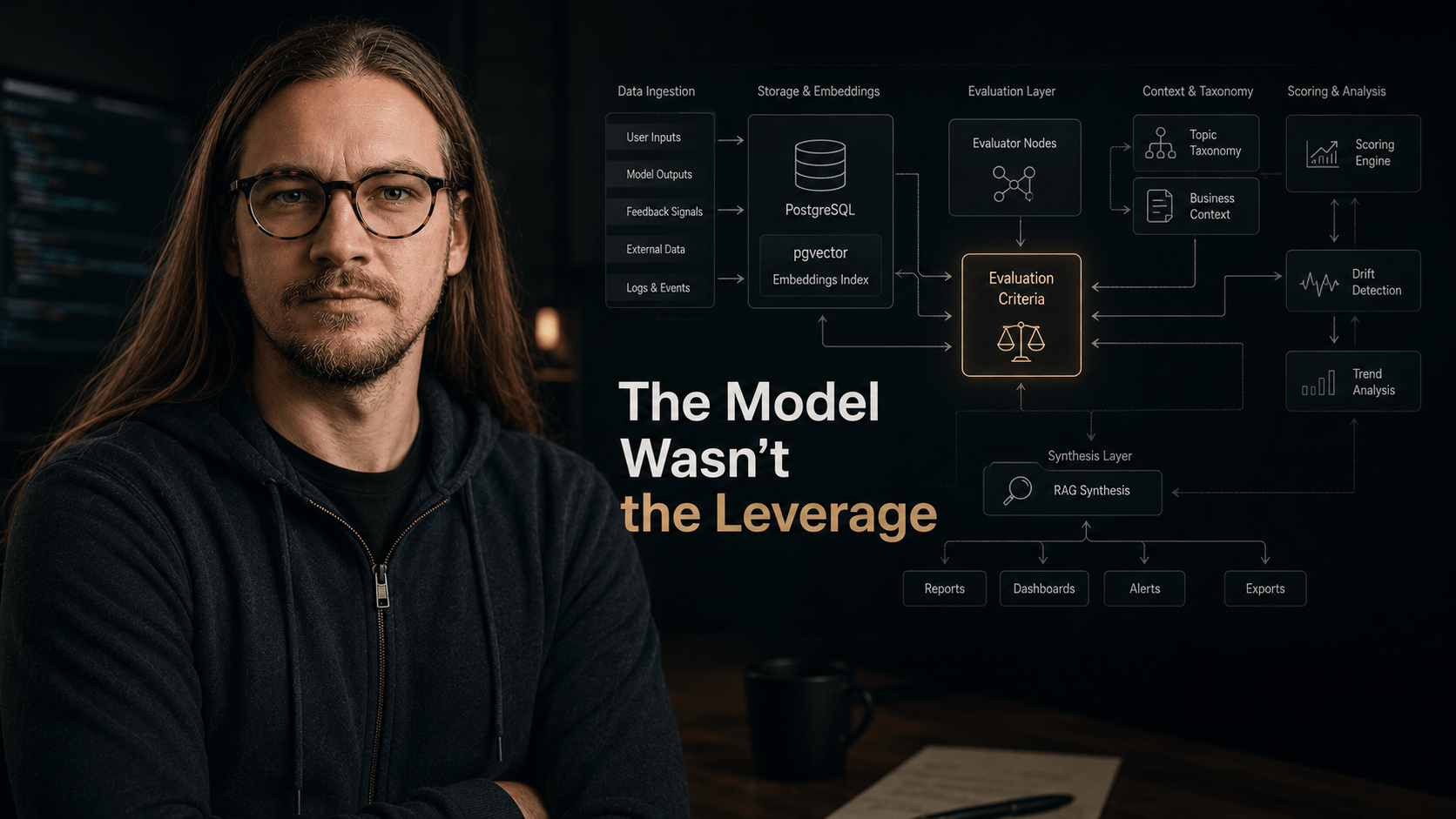
LinkedIn metrics lack signal. I built a local pipeline: scrape posts, score against a CTO/founder goal, classify topics—Ruby, Postgres, Ollama, caching, RAG rollup.
LinkedIn gives you data.
Signal? Not always.
For months I stared at the native analytics dashboard trying to answer one simple question:
what content actually moves me toward the kind of people I want to work with?
Not “what got impressions.” Not “what got dopamine.” Actual signal.
Because look — dashboards love showing numbers. Numbers feel smart. But most analytics are basically a car dashboard that proudly tells you the wheels are spinning without explaining why you’re driving into a ditch.
So I built my own evaluation pipeline.
Not because “AI”. Because I got tired of guessing.
The actual problemLink to section: The actual problem
LinkedIn analytics tells you what happened.
It rarely tells you:
- which topics attract CTOs and founders specifically
- what kind of posts generate inbound conversations
- where you’re drifting into content noise
- whether you’re building positioning or just farming engagement
You get metrics.
You don’t get decisions.
Different thing.
What the system doesLink to section: What the system does
1. Pulls full post contentLink to section: 1. Pulls full post content
LinkedIn exports are kinda funny.
You get links, timestamps, reactions. But not the actual thing people read.
So I use Playwright to scrape every post body into PostgreSQL.
Because analyzing “engagement” without content is like debugging production from CPU graphs only. Good luck with that.
2. Scores posts against a real goalLink to section: 2. Scores posts against a real goal
This is the part most “AI analytics” tools quietly skip.
You first need to define: what does “good” even mean?
My goal is simple:
attract inbound opportunities from CTOs, founders, and technical leadership.
So every post gets scored across six dimensions:
- audience fit
- technical depth
- problem clarity
- business impact
- inbound potential
- signal vs filler
Each score comes with rationale. No magic black box nonsense.
Basically I wanted something closer to: “why this worked” instead of “congrats, number go up.”
3. Maps topics against outcomesLink to section: 3. Maps topics against outcomes
Every post gets classified into topic buckets:
- backend scaling
- system design
- engineering leadership
- AI engineering
- hiring
- reliability
- CTO/founder perspective
- etc
Then I compare that against engagement and inbound patterns.
And honestly, some results were uncomfortable.
Some high-effort posts performed terribly against the actual goal.
Meanwhile some simple posts with:
- one real production problem
- one non-obvious insight
- one strong opinion
…worked significantly better.
Which is a useful reminder:
Effort is not value.
Alignment is.
StackLink to section: Stack
Nothing exotic, honestly.
- Ruby 4
- PostgreSQL + pgvector
- Sequel
- Playwright
- RubyLLM
- Ollama
- local models
- Solid Queue
No hosted AI APIs. No “AI SaaS platform”. No VC-funded abstraction lasagna.
Just boring infrastructure solving a concrete problem.
Funny how often that still works.
The interesting partLink to section: The interesting part
The biggest lesson was not about models.
I used open-source models end-to-end.
The important part was the evaluation contract.
Meaning:
- what “good” means
- what success means
- what dimensions matter
- what drift looks like
Honestly, this is where many AI projects go sideways.
Teams spend weeks debating models like they’re choosing a religion.
Meanwhile nobody clearly defines:
- goals
- scoring
- failure modes
- feedback loops
So the system produces statistically sophisticated confusion.
The broader patternLink to section: The broader pattern
This architecture works almost anywhere you have:
- a defined goal
- historical data
- a scoring system
Content strategy. Lead scoring. Hiring funnels. Support quality. Sales messaging. Engineering reviews.
Same loop every time:
define good → score reality → detect drift → refine
Basically production engineering, just applied to decision systems.
Five questions before building production AILink to section: Five questions before building production AI
- What exactly are you optimizing for?
- How do you measure “good”?
- What taxonomy are you using?
- What score is acceptable without review?
- How do you detect drift over time?
If these answers are vague, the model is not your bottleneck.
The thinking is.
This is also why I increasingly distrust generic “AI strategy” conversations.
A lot of them sound impressive right until you ask: “Okay. What exact business decision improves because of this?”
And suddenly the room becomes quieter than a Kubernetes cluster after someone accidentally deleted production.
Comments powered by Disqus.